Göbekli Tepe: the site
A hilltop in Upper Mesopotamia where, more than eleven thousand years ago, hunter-gatherers raised the oldest monumental architecture known anywhere on Earth.
What it is
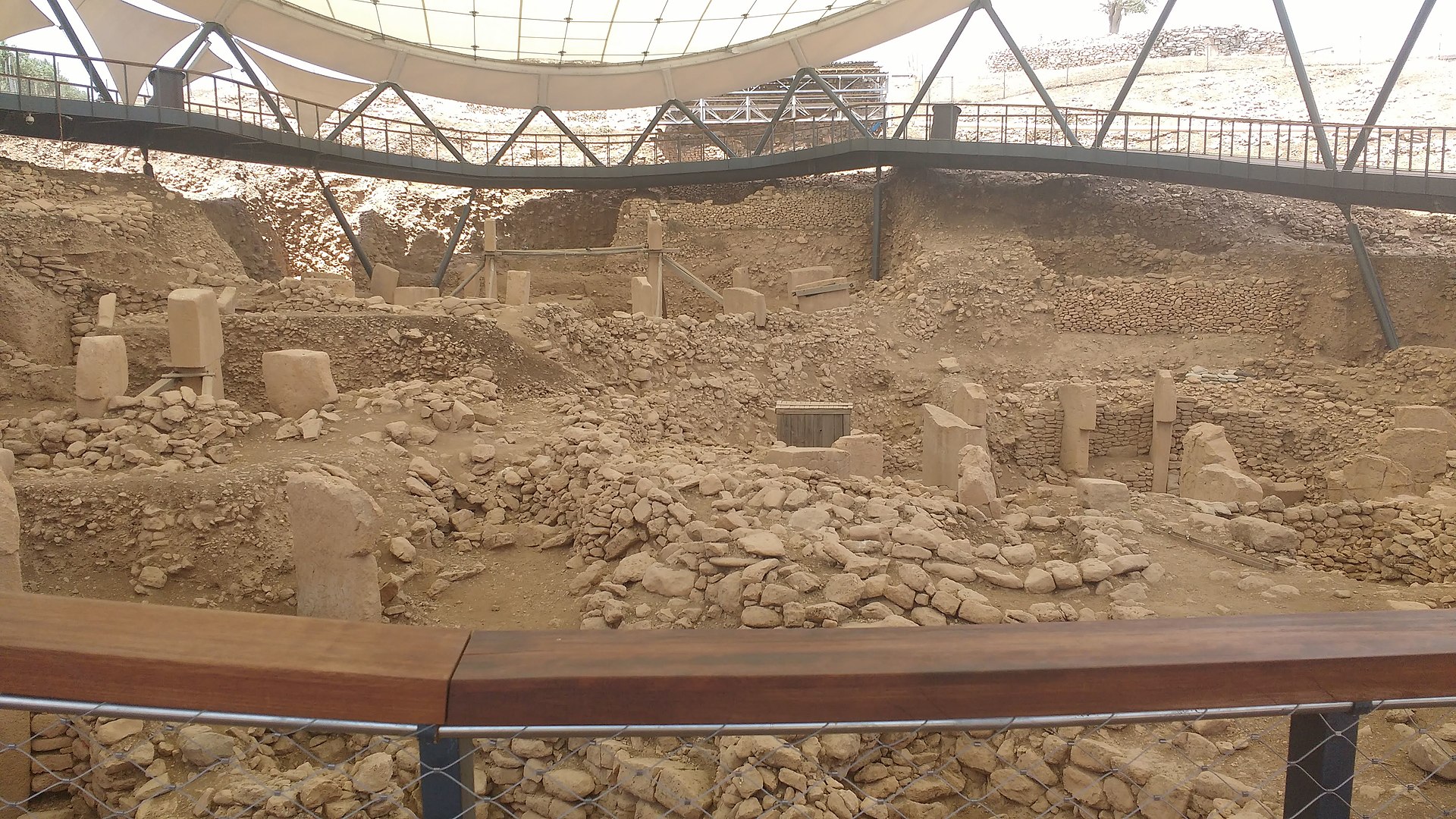
Göbekli Tepe is a Neolithic site on a limestone ridge in south-eastern Türkiye — a complex of monumental round and oval structures, with later rectangular buildings, each ringed by carved T-shaped limestone pillars. The pillars stand in walls and stone benches around two larger central pillars, and many are decorated with reliefs of foxes, snakes, wild boar, vultures and other creatures. The name means "potbelly hill" in Turkish, after the rounded mound that the buried structures created over millennia.
What makes the place extraordinary is who built it and when. These structures were raised by hunter-gatherers — before pottery, before metal, before the wheel and writing, and largely before farming. Quarrying, carving and erecting pillars of several to tens of tonnes was once thought to require settled, agricultural societies. Göbekli Tepe shows it did not.
Where it is
The site sits in the Örencik area, roughly 15 km north-east of Şanlıurfa in south-eastern Türkiye, on a ridge overlooking the Harran plain. It is comfortably reached as a day trip from the city, and is the flagship of a wider Neolithic landscape — the Taş Tepeler ("stone hills") — that includes nearby sites such as Karahan Tepe.
How old it is
Göbekli Tepe belongs to the Pre-Pottery Neolithic A and B periods, with activity spanning roughly 9500–8000 BCE; the earliest monuments date to about 9500–9000 BCE. That makes it some 6,000 years older than Stonehenge and about 7,000 years older than the Egyptian pyramids. Only a small fraction of the site — on the order of 10% — has been excavated, so the picture is still emerging.
Why it matters
For decades the standard story held that monumental and religious architecture followed the rise of farming and settled life: first the farm, then the village, then the temple. Göbekli Tepe inverts the sequence. Here, large-scale communal building appears among mobile hunter-gatherers, and the analysis of more than 100,000 animal bones — all from wild species — confirms the builders were not yet farmers.
That single fact reframes the Neolithic Revolution: the transition to agriculture and settled life may have been shaped by social, communal and ritual life as much as by economics. The site is popularly called "the world's oldest known temple," but this is an interpretation rather than settled fact. Klaus Schmidt, who recognised the site's significance in 1994, argued it was a "pure" sanctuary. The current research team de-emphasises that view: grinding stones, large cisterns and other domestic evidence suggest ritual and everyday life coexisted here. The story of Göbekli Tepe is, in part, a story of how interpretations change as more is excavated.
A UNESCO World Heritage Site
Göbekli Tepe was inscribed on the UNESCO World Heritage List on 1 July 2018, at the 42nd session of the World Heritage Committee in Manama. It is recognised under three criteria:
- Criterion (i) — a masterpiece of human creative genius, in its monumental T-pillars and reliefs.
- Criterion (ii) — an important interchange of human values during the early Neolithic of Upper Mesopotamia.
- Criterion (iv) — an outstanding example of a building type and landscape illustrating a significant stage in human history.
Excavation is ongoing and interpretations continue to evolve. Figures such as the number of buried enclosures, pillar weights and the function of the site are best understood as current scholarly estimates, not final answers.
Keep reading
Continue exploring
The enclosures
The four great circles — A, B, C and D — and how each is built.
The discovery
From overlooked flints to Klaus Schmidt and World Heritage status.
Heritage sites
Urfa Man, the Şanlıurfa Museum and the wider Taş Tepeler landscape.
Plan your visit
The canopy, the boardwalk and how to see it for yourself.